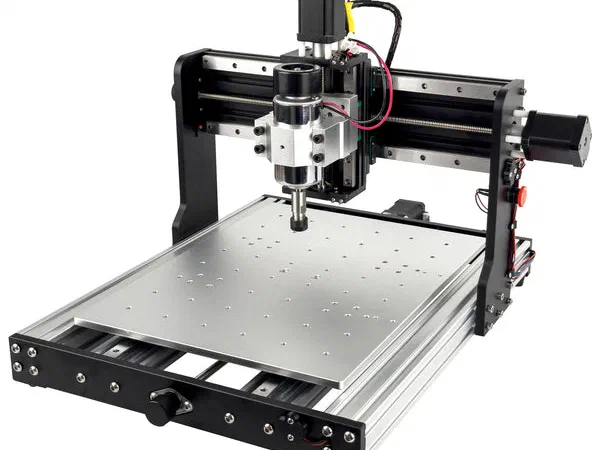
About the Machine
AnoleX no longer sells this model, but it remains fully supported in Easel. The 3030-Evo Pro has 287 x 300 x 73 mm of XYZ travel on a 300 x 400 mm table, a 300W spindle with an ER11 1/8in collet, dual steel linear guide rails on all axes, and Nema 17 steppers rated 650 mN·m.
Cut Settings on this Machine
Every cut starts with one formula: Feed Rate = Spindle Speed (RPM) x Chip Load x Number of Cutting Edges (flutes). Chip load is the thickness of material each cutting edge removes in one revolution of the bit. This number comes from the manufacturer of the bit, which publishes a chip-load chart for each bit diameter and material. Look up your exact bit and material, start from the middle of the published range, and you have the third number in the formula. The chart below shows the recommended spindle speed for each material and bit type.
| Material | Solid carbide bit (RPM) | HSS & carbide-tipped bit (RPM) |
|---|---|---|
| Plastic (hard & soft) | 18,000 | 8,000 |
| Soft woods (MDF, particleboard, etc.) | 22,000 | 10,000 |
| Hard wood (oak, maple, etc.) | 16,000 | 7,000 |
| Aluminum | 12,000-14,000 | 5,500 |
| Aluminum, softer grades (such as 3003) | 10,000 | 5,000 |
| Foam (harder foams; soft foams do not rout well) | 18,000 | 8,000 |
| Composites | 12,000 | 5,000 |
If this machine's spindle cannot reach the listed speed, run the spindle at its maximum and control the cut with feed rate. For 65mm trim routers, the DeWalt DW611 dial maps to: 1 = 16,000; 2 = 18,200; 3 = 20,400; 4 = 22,600; 5 = 24,800; 6 = 27,000 RPM.
The 3030-Evo Pro’s 300W spindle is a light-duty unit, and AnoleX does not publish a max RPM for it, so check the rating plate before you start. Small spindles like this lose torque fast once you push speed and load together, so let the feed rate do the work instead of the spindle. Dual steel linear guide rails on all three axes keep it accurate, but this is a compact desktop machine, not an industrial frame. A truly rigid machine with a powerful spindle can cut as deep as the bit is wide in a single pass, but that takes real spindle torque, a drive train and clamps that hold firm, a gantry that will not flex, and enough mass to soak up vibration. The 3030-Evo Pro falls short of that bar, so take shallower passes. Push too deep and the bit deflects and chatters, leaving scalloped edges, or it rubs instead of cutting and burns the material. The fastest way to dial in a cut is to see what has already worked for other people.
Worked example for feed rate: 1/8in (3.175mm) two-flute solid carbide end mill in hard wood. The chart says 16,000 RPM. With the bit maker’s 0.025mm per tooth (0.0010 in): 16,000 x 0.025 x 2 = 800 mm/min (31 in/min) feed. For depth per pass, start shallow and check Community Cut Settings in Easel for what works on the AnoleX 3030-Evo Pro. If the cut sounds strained, reduce the depth, not the feed. Slowing the feed below the chip load makes the bit rub instead of cut.
Community Cut Settings shows the spindle speed, feed rate, and depth per pass other makers actually run for your machine, material, and bit.
CNC has never been easier
Using this machine with Easel
AnoleX no longer sells the 3030-Evo Pro, but it remains fully supported in Easel. The AnoleX 3030-Evo Pro runs GRBL 1.1h, so it connects directly to Easel. Install the free Easel Driver and plug in over USB, or connect driverless with Rapid Connect in a Chromium browser (Chrome, Edge, or Opera). Design in the browser, then the Carve button homes, zeroes, and runs the job with live progress. You can also export G-code to run from another sender. Select AnoleX 3030-Evo Pro in Easel’s machine menu to size the canvas.
Prefer not to install anything? Rapid Connect lets any GRBL machine, this one included, connect straight from your browser. If you go the driver route, grab it from the downloads page and follow the step-by-step install guide.
Try Easel Free →Start creating with your CNC
Create your free Easel account and connect your machine in minutes.
Easel Free Trial →